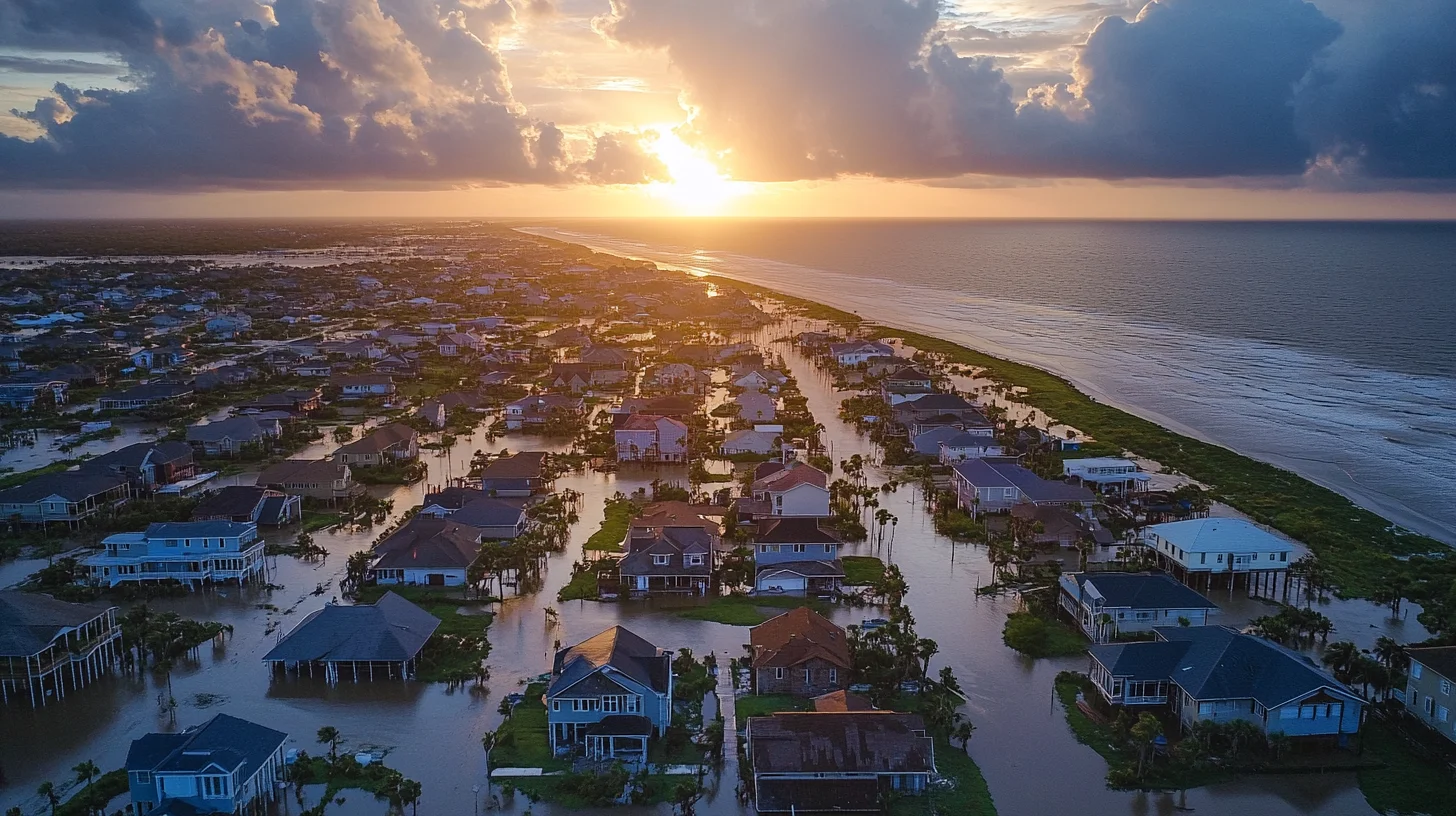
Texas's 14 first-tier Gulf Coast counties fall under the Texas Windstorm Insurance Association (TWIA). As of April 1, 2026, all new roof work must comply with the 2024 IRC/IBC to receive a WPI-8 Certificate of Compliance — mandatory for TWIA coverage eligibility. Without that certificate, your windstorm claim can be denied regardless of damage. TWIA implemented a 0% rate increase for 2026 under HB 3689.
Storm damage on Texas Gulf Coast roofs
Hurricane-force winds, Gulf hail, and salt air combine to create damage that often isn't visible from the street.
In TWIA counties, wind uplift is the primary threat — sustained Category 3 and 4 winds can break the seal on every shingle course simultaneously. Harvey (2017) demonstrated how rainfall-driven roof damage compounds wind damage: over 204,000 Texas homes filed roofing claims. Salt air from the Gulf accelerates fastener corrosion and granule loss, meaning coastal roofs age faster than inland.
Class 3 and Class 4 impact-resistant shingles are strongly recommended across the Coastal Bend — they reduce storm claims by 60–80% and qualify for TWIA premium discounts that compound annually over the roof's lifespan.
🌀 Recent Texas storm benchmarks
Harvey (2017), Imelda (2019), and the 2021 Winter Storm Uri are the recent Texas benchmarks. Harvey alone produced $125 billion in damages and over 500,000 roofing claims across the Houston metro.
Coastal roof types & how they hold up in Texas
The right roof for a Texas coastal home balances wind rating, cost, and local climate exposure.
Architectural shingle
Most common coastal choice. Class 4 impact-rated shingles qualify for TWIA discounts and reduce claims significantly.
Metal roofing
Excellent for Gulf exposure — corrosion-resistant fasteners, high wind ratings, long lifespan in salt-air environments.
Concrete tile
Common in South Texas. Heavy and wind-resistant; requires structural review and TDI inspection after storm impact.
📋 Texas building code overview
TWIA's 14 designated catastrophe area counties — Aransas, Brazoria, Calhoun, Cameron, Chambers, Galveston, Jefferson, Kenedy, Kleberg, Matagorda, Nueces, Refugio, San Patricio, and Willacy, plus parts of Harris County — require WPI-8 certification after any structural roof work. The 2024 IRC/IBC applies to all projects started after April 1, 2026.
2026 roof repair & replacement ranges
Ranges reflect 2026 quotes from licensed Texas roofers in coastal counties. TWIA-required WPI-8 certification adds modest cost but is mandatory.
| Roof work | Typical range | Best for |
|---|---|---|
| Minor storm repair | $350 – $1,500 | Missing shingles, small leaks, flashing |
| Section / slope replacement | $1,500 – $6,500 | Wind or hail damage, one slope |
| Full roof replacement | $9,000 – $27,000+ | Major storm damage, aging coastal roof |
| Free inspection | $0 | Every homeowner after a storm |
WPI-8 certification through TDI is required after structural roof work in TWIA counties. Factor this into your project timeline — TDI inspectors must sign off before coverage is restored.
Your roofing product or service here. Reach homeowners actively comparing storm-damage roofing options across 13 coastal states. High-intent audience, zero waste.
Storm roof claims in Texas
Standard Texas homeowner policies in TWIA counties typically exclude wind and hail — you need separate TWIA coverage for those perils.
TWIA's residential coverage limit is $1,773,000 for 2026. If your home exceeds that value, a private excess wind policy fills the gap. After any roof work, a WPI-8 Certificate of Compliance is mandatory to maintain TWIA eligibility. Texas also saw 0% TWIA rate increases for 2026 under HB 3689, and HB 2518 now allows direct interest-free installment payments to TWIA.
💰 Wind-mitigation discounts in Texas
Texas homeowners who install impact-resistant Class 3 or Class 4 roofing materials qualify for TWIA premium discounts. The discount applies annually and compounds over the roof's lifespan. Your licensed roofer documents the qualifying installation on the WPI-8 certification form submitted to TDI.
What to do once it's safe
Stay safe & tarp if needed
Don't climb a damaged roof. Cover active leaks from inside and call a pro for emergency tarping if water is actively entering. Step-by-step tarp guide →
Document everything with dates
Take dated photos of all visible damage — roof surface, ceilings, walls, attic, and any affected belongings. Date and timestamp are critical for claim correlation.
Get a free licensed inspection
A licensed local roofer assesses hidden damage — shingle seal failure, deck saturation, flashing separation — and produces a written report for your claim.
File within your window
Submit your claim promptly with the inspection report. Most Texas policies allow one year from the date of loss — but earlier is always stronger.
TWIA claims have a strict filing window
Texas storm season peaks June through November, and TWIA filing deadlines close quickly after any declared event. A free inspection now — with dated photos and a written assessment — is the documentation that keeps your claim valid and your WPI-8 compliance current.
How to verify a roofer in Texas
After any major storm, unlicensed contractors target affected neighborhoods. Here is how to protect yourself.
Texas roofing contractors must hold a state-issued license under Texas Occupations Code Chapter 1305. Verify any contractor at the Texas Department of Licensing and Regulation (TDLR) website. In TWIA counties, also confirm they are familiar with TDI WPI-8 certification requirements — not all licensed roofers are experienced with the TWIA inspection process.
Verify state license
Check the state licensing board before signing anything.
Confirm insurance
Ask for a certificate of liability and workers' comp.
Use a local roofer
Local contractors know your county's permit process and are accountable after the job.
Licensed & insured
we connect you with local Texas contractors and stay out of your way — no commission, no pressure.
State licensed
Contractors in our Texas network represent themselves as state-licensed. Always verify before signing — check tdlr.texas.gov ↗
Fully insured
Liability and workers' compensation insurance confirmed on every contractor.
Local experience
Pros who know Texas code, your county's permit office, and local claim patterns.
Texas counties we cover
Pick your county for its local storm history, windstorm-coverage notes, 2026 pricing, and licensed roofers near you. Each county page lets you drill down to your city.
Get your free Texas roof inspection
No cost, no obligation. A licensed local roofer typically reaches out within 24–48 hours.
Request received!
A licensed local roofer will reach out within 24–48 hours to schedule your free Texas inspection.