Generator Safety <span class=After a Storm" loading="eager" fetchpriority="high" style="position:absolute;inset:0;width:100%;height:100%;object-fit:cover;z-index:0">
Life Safety · Storm Recovery
Generator Safety After a Storm

Carbon monoxide kills more people after a hurricane than during it. Read this before you start your generator.

Life Safety — Read Before You Start Your Generator

Generator safety after a storm — carbon monoxide kills more people than the hurricane itself

In the days following a major hurricane or tropical storm, carbon monoxide (CO) poisoning from improperly used generators consistently kills more people than the storm winds, storm surge, or flooding. After Hurricane Ian, at least 11 people died from CO poisoning. After Ida, 8. After Harvey, the number was even higher. These deaths happen in homes that survived the storm — to people who did everything right during the hurricane and then ran a generator in the wrong location afterward.

This guide covers every aspect of safe generator operation after a storm: where to place it, how far away, what to connect, what not to connect, CO detector placement, fuel safety, and the specific mistakes that turn a power solution into a fatal emergency.

Understand the Threat

Why carbon monoxide is so deadly — and why generators are the leading source after storms

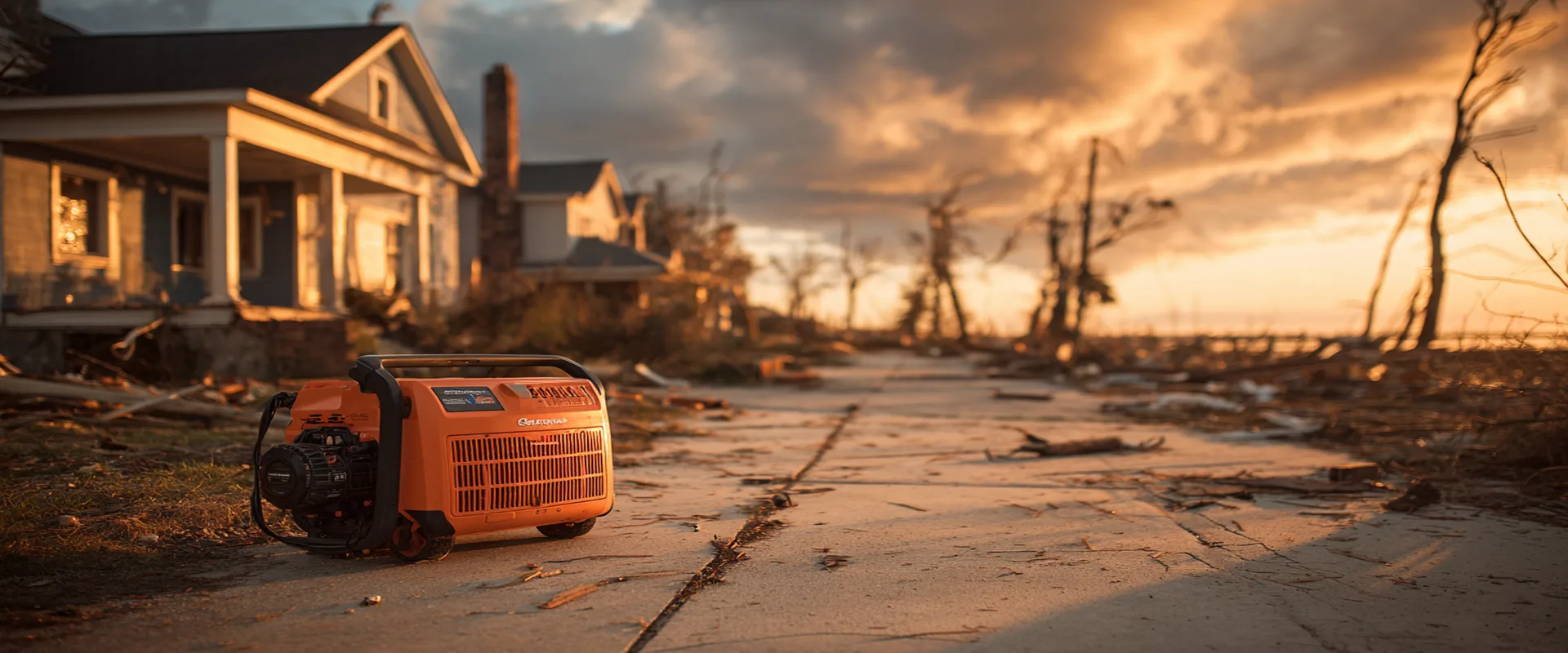
Portable generator running safely outdoors after hurricane

What carbon monoxide does to the body

Carbon monoxide is colorless, odorless, and tasteless. You cannot detect it without an instrument. It binds to hemoglobin in your blood 200–250 times more readily than oxygen — meaning it displaces oxygen at the cellular level, starving your brain, heart, and organs of what they need to function. Early symptoms — headache, nausea, dizziness — are indistinguishable from the flu or heat exhaustion, which are both common after storms. Many victims never realize they're being poisoned.

At moderate concentrations, CO causes confusion and disorientation — which eliminates your ability to recognize the emergency and act on it. At higher concentrations, loss of consciousness occurs within minutes. At very high concentrations, death follows in under an hour. People die in their sleep. People die sitting in chairs. The storm survivors who run a generator in an attached garage or enclosed porch often never wake up.

⚠️ CO concentration and effects

35 ppmOSHA 8-hour limit — headache after sustained exposure 200 ppmHeadache, dizziness, nausea within 2–3 hours 400 ppmLife-threatening within 3 hours 800 ppmConvulsions, death within 2–3 hours 1,600 ppmDeath within 1 hour 6,400 ppmDeath within 15–25 minutes

A typical 5,500-watt portable generator running at full load produces approximately 3,000–5,000 ppm CO in a closed single-car garage within minutes. An attached garage with the door closed and air gaps into the home can raise CO levels throughout the house to lethal levels in under 30 minutes.

Why it's worse after storms

Post-storm conditions amplify CO risk: homes are sealed against rain and wind, normal ventilation is disrupted, people are exhausted and don't think clearly, CO detectors may have dead batteries or be damaged by flooding, and the urgency of keeping the lights on or running medical equipment pushes people to take shortcuts they normally wouldn't.

The Most Important Rule

Where to place your generator — the rules that keep you alive

🚫 NEVER run a generator in any of these locations

  • Inside your home — any room, any floor, with any amount of ventilation
  • Inside an attached garage — even with the garage door fully open. CO travels through gaps, door frames, and any air connection to the house interior.
  • Inside a detached garage — even with doors and windows open. CO builds up faster than it disperses.
  • Under a carport — overhead cover creates a concentration zone
  • On a covered porch or lanai — screen enclosures and roof overhangs trap exhaust
  • Near any open window, door, or vent — CO follows the airflow directly inside
  • In a shed or enclosed outbuilding — same as a garage
  • Near any neighbor's home — you can poison neighboring households if placed close to a shared wall, window, or AC intake

✅ Where to run your generator safely

Outdoors, minimum 20 feet from any door, window, or vent. The Consumer Product Safety Commission's recommendation is 20 feet. More is better. The prevailing wind direction matters — position the generator so wind carries exhaust away from the house, not toward it.

Think about your neighbors too. A generator placed at the corner of your lot may be 20 feet from your windows but only 8 feet from your neighbor's. Position with awareness of all nearby homes and structures.

The exhaust outlet on your generator should point away from all structures. Do not place it against a wall or fence that will reflect exhaust back toward the home.

✅ Safe placement checklist

  • At least 20 feet from any door, window, or vent
  • Outdoors only — no enclosure of any kind
  • Exhaust pointed away from all structures
  • Positioned upwind or crosswind from the house
  • On a dry, level surface away from flood risk
  • Not under any overhang, tree canopy, or awning
  • At least 20 feet from neighboring homes
  • Away from AC unit intakes (AC pulls outside air in)

The "open garage door" myth

The most dangerous misconception about generator safety is that running one in an attached garage with the door fully open is acceptable. It is not. Testing by CPSC and NFPA has demonstrated that a generator running in an open attached garage can raise CO levels throughout the adjoining home to dangerous concentrations within minutes — because CO is heavier than the incoming fresh air and distributes through gaps around the door, HVAC returns, and structural openings that exist in every home between garage and living space.

There is no safe way to run a generator inside any attached structure. Twenty feet outdoors, exhaust pointed away from the house, is the only safe configuration.

Your Early Warning System
Free — No Obligation

Get a licensed roofer to inspect your roof

One request. Up to 3 free estimates from licensed local contractors. Takes under a minute.

Carbon monoxide detectors — what you need, where to put them, and why batteries matter right now

Where to install CO detectors

CO detectors are required by law in most Gulf and Atlantic coastal states when a fuel-burning appliance (including a generator) is in use. Even where not legally required, they are essential. Here's where to place them:

  • Every bedroom hallway — within 10 feet of each sleeping area. CO poisoning during sleep is the most common fatal scenario.
  • Every floor of the home — CO can stratify at different levels depending on ventilation and temperature
  • Near any attached garage entry — this is the highest-risk infiltration point
  • Near any fuel-burning appliance — gas range, water heater, furnace — these produce CO independent of the generator
  • Not in enclosed cabinets — CO detectors need free air circulation to function correctly
  • Not directly above or adjacent to fuel-burning appliances — transient CO during appliance startup will trigger false alarms

Detector types and battery rules

CO detectors are inexpensive and non-negotiable. Options:

  • Battery-only detectors — essential for post-storm use since power may be out. Replace batteries at the start of every hurricane season. A CO detector with a dead battery is decoration.
  • Hardwired with battery backup — best for permanent installation. Backup battery keeps it active during outages.
  • Combination smoke/CO detector — convenient but confirm it has battery backup and that the CO function works independently of AC power.
  • Digital display models — show actual PPM reading, not just alarm threshold. Worth the extra cost — lets you see low-level accumulation before it reaches alarm levels.

Replace batteries before every storm season. A CO detector with depleted batteries is more dangerous than having no detector — it creates false confidence. Test every detector when you replace batteries. Do it in April, before June 1.

🚨 If your CO alarm sounds — do this immediately

  1. Get everyone out of the building immediately — do not stop to gather belongings, do not investigate the source, do not try to open windows first
  2. Leave the door open as you exit — this helps vent the building
  3. Call 911 from outside — even if everyone seems fine. CO exposure that doesn't cause symptoms yet can cause delayed cardiac effects.
  4. Do not re-enter for any reason until emergency services have cleared the building

Seek medical attention even if you feel fine. CO poisoning can cause cardiac arrhythmia hours after exposure. Anyone who was in the building when the alarm sounded should be evaluated by a medical professional — especially children, elderly individuals, and anyone with heart or respiratory conditions. Tell the ER you were exposed to carbon monoxide from a generator.

Do not silence the alarm and go back to sleep. This happens. It kills people. A CO alarm is not a nuisance alarm — it is a medical emergency. If it goes off, everyone leaves, and 911 is called.

Smart Load Management

What to power — and what not to power — with your generator

Most post-storm generator deaths involve overloaded generators being pushed beyond their rated capacity — which increases CO output — and generators connected incorrectly to home circuits. Here's how to load your generator safely and effectively.

✅ Priority loads — run these first

Medical equipment

CPAP machines, oxygen concentrators, dialysis equipment, refrigerated medications. These are life-critical. Calculate their wattage requirements and reserve generator capacity for them before anything else.

Refrigerator and freezer

A full freezer stays safe for 48 hours without power if the door stays closed. A refrigerator is safe for 4 hours. Cycle the generator to run the fridge periodically rather than running continuously — this conserves fuel significantly.

Sump pump

If your home has a sump pump, power it continuously during and after heavy rain. A flooded basement during a power outage causes damage that often exceeds the storm damage itself.

Dehumidifier and fans

Critical for storm water intrusion — running these continuously stops the mold clock. See the dry-out guide for wattage requirements.

Phone and device charging

Communications are critical for coordinating repairs, reaching family, and accessing emergency services. Keep phones charged before fuel runs low.

🚫 What NOT to connect — avoid these mistakes

Central air conditioning

A central AC unit typically draws 3,000–5,000 watts. Running it on a portable generator will push the unit to or beyond its rated capacity, dramatically increasing CO output and engine wear. Use window units or fans instead.

Electric stove, oven, or dryer

These are high-draw 240V appliances. Most portable generators output 120V only. Attempting to run them will either fail to start them or overload the generator. Use a camp stove or gas grill outdoors for cooking.

Your home's main electrical panel (backfeeding)

Connecting a generator to your home panel without a proper transfer switch is illegal, dangerous, and potentially lethal to utility workers restoring power. If the generator backfeeds into the grid, the line workers believe the line is de-energized. It isn't. This kills people. Use extension cords or a licensed electrician-installed transfer switch.

More load than the generator's rated wattage

An overloaded generator runs at maximum engine speed continuously, producing 3–4x more CO than a lightly loaded unit and dramatically shortening its lifespan. Calculate total wattage before connecting appliances. Running at 75–80% of rated capacity is ideal.

Generator sizing — what capacity do you actually need?

Appliance Running Watts Starting Watts Notes
Refrigerator150–400800–1,200Cycles on/off — plan for starting surge
Chest freezer100–400600–1,200Cycles — similar to fridge
50-pint dehumidifier700–800900–1,000Run continuously after water intrusion
Box fan (20")200–300200–300No starting surge — steady draw
Window AC (10,000 BTU)900–1,2002,200–3,000High starting surge — size generator accordingly
Sump pump (1/2 HP)800–1,0001,500–2,000High starting surge — critical to account for
CPAP machine30–6030–60Low draw — always prioritize
Oxygen concentrator150–600300–800Varies by flow rate — check your unit's label
LED lighting (10 bulbs)60–10060–100Negligible — LEDs are highly efficient
Laptop computer45–10045–100Use a UPS or surge protector
Typical post-storm essential load2,000–3,5004,000–6,000Fridge + dehumidifier + 2 fans + lights + charging

Practical recommendation: A 3,500–5,000 watt generator handles the post-storm essential load comfortably. A 2,000-watt inverter generator (quieter, more fuel-efficient) can handle the essentials if you cycle loads carefully — run the fridge and dehumidifier simultaneously but cycle off other loads when starting high-surge appliances.

The Second Biggest Risk

Fuel storage and refueling safety

Storm damage assessment after hurricane

Generator fires from improper fueling are the second most common cause of post-storm generator injuries and deaths after CO poisoning. Fuel safety is straightforward but requires discipline — especially when you're exhausted and just want to keep the power on.

🔥 Fueling rules — non-negotiable

  • ALWAYS let the generator cool for at least 2 minutes before refueling. Spilled gasoline on a hot engine ignites instantly. This is the most common cause of generator fire injuries — people refueling a hot running engine.
  • NEVER refuel while the generator is running. Shut it down, wait for the engine to cool, then refuel.
  • Refuel outdoors only — gasoline vapors are heavier than air and pool at floor level. A spark anywhere in the vicinity ignites them.
  • Use an approved fuel container — red ANSI-approved gasoline containers only. Never use unapproved containers, milk jugs, or water bottles.
  • Do not overfill — leave room for fuel expansion. Overfilled tanks spill when the engine warms up.
  • Clean up spills immediately before restarting.

📦 Pre-storm fuel storage

  • How much to store: A 5,500-watt generator at half load burns approximately 0.5–0.75 gallons per hour. For 72 hours of cycling operation, plan for 20–30 gallons minimum. After a major hurricane, gas stations may be without power or out of fuel for 5–10 days.
  • Fuel stabilizer is mandatory for stored gasoline. Untreated gasoline degrades in 30 days, gumming carburetors and fuel systems. Add fuel stabilizer (STA-BIL or equivalent) to every can of stored fuel. Treated fuel stays viable for 12–24 months.
  • Storage location: In a detached shed or outbuilding — not attached to the home. Never in the living space. Gasoline vapors are highly flammable and accumulate in enclosed spaces.
  • Rotate fuel annually — use stored fuel in your vehicle, refill fresh at the start of each storm season.
  • Propane generators eliminate fuel stability concerns and are significantly safer to store — worth considering for your next generator purchase.
Often Overlooked

Extension cords — the right gauge for the job

Undersized extension cords are a fire hazard, a damage risk to appliances, and a source of significant power loss. The further your generator is from the house — and at 20 feet minimum it should be reasonably far — the heavier the cord you need. Using the wrong extension cord is one of the most common generator mistakes.

Load (Watts) 25 ft cord 50 ft cord 100 ft cord Notes
Up to 1,000W14 AWG14 AWG12 AWGFans, phone chargers, small appliances
1,000–2,000W14 AWG12 AWG10 AWGDehumidifier, window AC
2,000–3,500W12 AWG10 AWG8 AWGRefrigerator + dehumidifier + fans
3,500W+10 AWG8 AWG6 AWGHeavy loads — use multiple cords or a power strip with surge protection

Extension cord rules

  • Use only 3-prong grounded cords — never 2-prong
  • Never run cords under rugs, through walls, or in areas where they can be damaged
  • Keep cords fully uncoiled when in use — a coiled extension cord under load generates heat
  • Never use indoor extension cords outdoors — use outdoor-rated (W, WA, WE, or WW marked) cords for the run from generator to house
  • Use a heavy-duty power strip with surge protection inside the home — this protects sensitive electronics from generator voltage fluctuations
  • Never connect more than one major appliance per outlet on the generator — spread loads across multiple outlets
  • Replace any cord that feels warm to the touch during operation — warmth means the cord is undersized for the load
  • The generator's outlets are the rating limit — do not use a power strip to add more load than the generator is rated for
Before the Season

Pre-season generator maintenance — do this every April

A generator that won't start when you need it is almost as dangerous as one used improperly — because the alternative is improvising in the dark after a storm. The most common post-storm generator failure is a unit that hasn't been run in a year, has stale fuel, or has a dead battery (on electric-start models). Ten minutes of maintenance in April prevents this entirely.

Annual maintenance checklist

1

Run it under load for 30 minutes. Connect a real load — a space heater or dehumidifier — and run it at working load. This burns off fuel varnish, circulates oil, and confirms everything functions. Running unloaded for 5 minutes is not a substitute.

2

Change the oil. Gasoline generators require an oil change every 100 hours or once per season. Check your manual. Running a storm-season generator on old oil dramatically shortens its life.

3

Check/replace the spark plug. A fouled spark plug is the most common reason a generator won't start after sitting. Inexpensive to replace, 5 minutes to do.

4

Check/replace the air filter. A clogged air filter causes the engine to run rich, increasing CO output and reducing efficiency.

5

Check battery (electric start models). Float-charge or replace the battery if it hasn't been maintained. A dead battery means manual pull-start — more difficult on a large generator and impossible for some people.

6

Test all CO detectors and replace batteries. Do this at the same time as generator maintenance — same day, same habit.

Storage best practices

  • Don't store with fuel in the tank long-term. If storing for more than 30 days, either add fuel stabilizer to the tank and run for 10 minutes to circulate it, or drain the fuel completely and run the carb dry. Stale fuel is the #1 cause of generator starting failures.
  • Cover it. Dust, insects, and moisture degrade carburetors and electrical components during storage. A generator cover costs $20–$30 and prevents $200+ in carburetor cleaning.
  • Store in a dry location. Moisture corrodes electrical contacts and fuel system components. A shed or garage is fine — just don't store fuel inside any attached structure.
  • Keep the manual. After a storm, in the dark, when you haven't run the generator in a year — you will need the manual. Keep it in a zip-lock bag attached to the generator.

Propane and natural gas generators eliminate fuel storage and stability concerns entirely. Dual-fuel models (gasoline + propane) offer the best of both. Standby generators connected to natural gas run indefinitely during extended outages with no refueling. If you're in the market for your first generator or replacing an aging unit, a dual-fuel or propane model is worth the modest price premium for coastal homeowners.

Common Questions

Generator safety after a storm — questions homeowners ask

Can I run my generator in the garage with the door open?

No. This is one of the most dangerous generator myths. An open garage door allows CO to accumulate in the garage at lethal levels, and CO seeps through every gap between the garage and your living space — door frames, HVAC ducts, electrical penetrations. Testing shows that a generator in an open attached garage can raise CO levels inside the home to dangerous concentrations in under 30 minutes. The only safe location is outdoors, at least 20 feet from any opening.

How far does my generator need to be from my house?

The CPSC recommends a minimum of 20 feet from any door, window, or vent. This is a minimum, not a target. More distance is always safer. Point the exhaust away from all structures. Account for wind direction — position so prevailing wind carries exhaust away from your home and your neighbors' homes. If your yard doesn't allow 20 feet, a longer extension cord that keeps the generator further away is the right solution.

My CO detector went off but I don't smell anything. Is it a false alarm?

Treat every CO alarm as real. CO is odorless — you will never smell it. The most dangerous assumption after a CO alarm is that it was a false alarm. Evacuate, call 911, and do not re-enter until emergency services have cleared the building. If the alarm continues to sound without a confirmed source after the building is cleared, replace the detector — CO detectors have a 5–7 year lifespan and may alarm as they age out.

Can I connect my generator to my house through a dryer outlet?

No. Connecting a generator to any household outlet — dryer, range, or otherwise — backfeeds electricity into the utility lines. This is called a "suicide cord" and it is illegal, will void your homeowner's insurance, and can electrocute utility workers restoring power to your neighborhood. If you want whole-house generator power, have a licensed electrician install a proper transfer switch. It takes a few hours and costs $500–$1,500 depending on your panel.

How long can I run my generator continuously?

Most portable generators are designed to run for 8–12 hours on a tank of fuel. For extended outages, cycle the generator — run it for 8 hours, shut it down for a few hours to cool completely, then restart. Continuous operation beyond 12 hours without cooldown accelerates engine wear and increases the risk of overheating. Check your manual for your specific model's recommendations. Inverter generators generally handle extended use better than conventional generators.

Is it safe to run a generator in the rain?

Generators are not waterproof. Running one in rain or standing water creates electrocution risk and can permanently damage the unit. Use a generator tent or canopy — purpose-built covers that allow airflow while protecting from direct rain. These cost $30–$80 at hardware stores and are worth keeping with your generator kit. Never cover the generator with a tarp that blocks airflow — that traps CO and heat, which is dangerous. Dry concrete or pavement is preferable to wet grass for placement.

My neighbor is running their generator and I can smell exhaust near my house. What do I do?

Close any windows and doors facing the exhaust source immediately. If the smell is entering your home, treat it as a CO hazard — CO is present wherever generator exhaust is detectable. Check your CO detectors. If readings are elevated or you feel symptoms (headache, nausea, dizziness), evacuate and call 911. For the non-emergency situation, speak to your neighbor about repositioning their generator — most people don't realize how far exhaust travels. Local ordinances in some municipalities restrict where generators can be operated relative to property lines.
Storm Damage to Your Roof?

Get a free inspection from a licensed local roofer

Same-day emergency tarping available across Gulf and Atlantic coastal markets. Get your repair documented before you need your generator again.

Request Free Inspection →
🚨 Emergency Help ×

Active leak or major storm damage? We can get someone to you fast — or help you tarp right now.

📞 Request Same-Day Callback 🛖 Emergency Tarping Guide →
Tap the red tab on the right edge to open or close this panel anytime.