Storm Recovery · Legal Rights
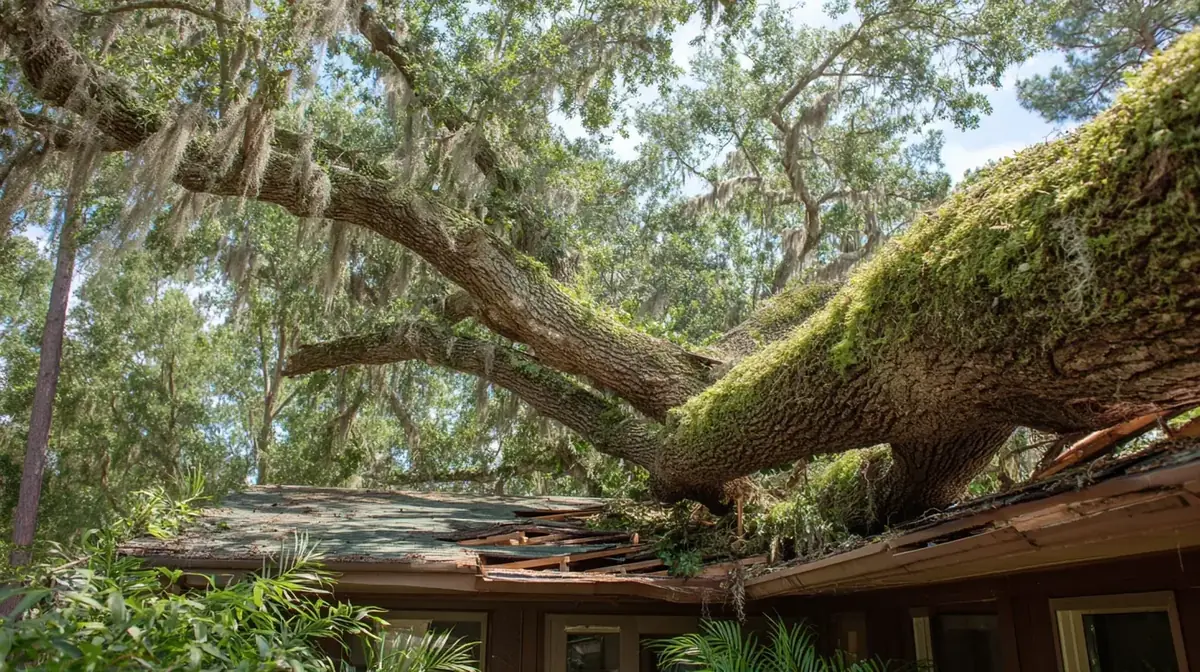
Neighbor's Tree Fell on Your Roof
Whose insurance pays? The answer surprises almost everyone — and getting it wrong costs you thousands.
Read the Guide ↓
Whose insurance pays? The answer surprises almost everyone — and getting it wrong costs you thousands.
Read the Guide ↓The short answer: your homeowner's insurance pays to repair your roof — not your neighbor's, even though it was their tree. This surprises almost everyone. It feels wrong. Neighbors argue about it. Some stop speaking over it. But in every state on the Gulf and Atlantic coast, the legal and insurance framework is the same: the tree landing on your property is your claim, on your policy.
There is an exception — if you can prove your neighbor was negligent (they knew the tree was dead, diseased, or dangerous and did nothing about it) — but proving negligence is harder than most people expect and rarely worth pursuing for the average storm damage claim. This guide explains the rules, the exceptions, every scenario you might face, and exactly what to do right now.
In U.S. property law, when a tree falls due to an Act of God — a storm, high winds, lightning — the owner of the tree is generally not liable for the resulting damage. The storm caused the damage, not the neighbor. Your homeowner's insurance covers damage to your property caused by windstorm and falling objects. The tree was a falling object. Your policy responds.
This isn't unique to any one state — it's the underlying common law principle that every Gulf and Atlantic coastal state's courts have consistently upheld. Your neighbor didn't do anything wrong. The storm did it.
Standard homeowner's policies (HO-3 form, which covers most coastal homes) include coverage for windstorm and falling objects as named perils — both of which apply when a neighbor's tree falls on your roof during a storm.
Your deductible applies. This is the part that stings most — you pay your deductible even though it was someone else's tree. There is no mechanism in the standard insurance framework to force your neighbor to cover your deductible unless you can prove negligence.
Your neighbor's homeowner liability coverage could respond — but only in a specific scenario: if you can prove they were negligent. Specifically, that they knew the tree was dead, diseased, structurally compromised, or dangerously leaning, and they failed to take reasonable steps to address it. This is a legal negligence standard — not just "that tree looked bad to me." Without documented notice and a failure to act, a storm-caused tree fall is an Act of God, and your neighbor has no liability.
Negligence is a higher bar than most homeowners expect. "The tree looked dead" is not enough. "I could see it was rotting" helps but still requires more. Here's what courts and insurers actually require to establish neighbor liability:
✅ Prior written notice
You or another party sent your neighbor a written letter (ideally certified mail) identifying the specific tree as a hazard, requesting its removal or trimming, and they failed to act within a reasonable time. This is the gold standard for establishing negligence — documented notice and documented failure to respond.
✅ Arborist report on file
A certified arborist had previously assessed the tree as diseased, structurally compromised, or hazardous — and that report was provided to the tree owner. If the arborist report existed and your neighbor ignored it, that's strong evidence of negligence.
✅ Municipal or HOA notice
Your city, county, or HOA had notified your neighbor in writing that the tree was a hazard and required action. Many municipalities do this proactively after inspection — a copy of that notice is valuable evidence.
🚫 "The tree looked dead to me"
Your personal observation without documented notice to the neighbor is generally insufficient. You need proof they knew — not that you could see it.
🚫 Verbal complaints to the neighbor
Unwritten conversations are nearly impossible to prove. "I told them three times" without documentation doesn't establish legal notice in most courts.
🚫 Post-fall observation that the tree was diseased
Discovering after the fact that the tree had rot or disease is helpful but not sufficient on its own — you must show the neighbor had prior knowledge and failed to act.
⚠️ Photos showing obvious decay pre-fall
Dated pre-fall photos of the tree showing visible rot, hollow trunk, dead limbs, or extreme lean can be supportive evidence — especially combined with a post-fall arborist assessment of the tree's pre-storm condition. Not a slam dunk on their own but meaningful in a claim.
Even if you don't pursue your neighbor directly, your insurance company might — through a legal process called subrogation. After paying your claim, your insurer has the right to step into your shoes and pursue the neighbor's liability insurer to recover what they paid out. If they succeed, you may get your deductible back.
This is worth knowing because: your cooperation with your insurer's subrogation investigation matters, and you should not sign any releases or agreements with your neighbor or their insurer without understanding how subrogation works. If you settle privately with your neighbor for your deductible and then sign a release, you may be blocking your insurer's subrogation rights — which could void your coverage or create a legal dispute with your own insurer.
Rule: Do not sign anything with your neighbor or their insurer before talking to your own insurer. Tell your insurer about the neighbor's tree immediately — they will advise you on subrogation and whether to pursue a direct claim against the neighbor.
One request. Up to 3 free estimates from licensed local contractors. Takes under a minute.
The most common scenario. Storm winds cause a healthy, well-maintained tree to fall onto your roof.
Your insurance pays: ✅ Yes
Neighbor liable: 🚫 No — Act of God
Your deductible applies. File your homeowner's claim same day. Neighbor has no obligation.
You or someone else notified the neighbor in writing that the tree was dead, diseased, or dangerous. They took no action. The tree fell.
Your insurance pays: ✅ Yes — file immediately
Neighbor liable: ⚠️ Possibly — if notice documented
File your claim first. Preserve all documentation of prior notice. Your insurer may pursue subrogation. Consult an attorney before settling privately.
Lightning is an Act of God. Even if the tree was perfectly healthy, the lightning strike caused it to fall.
Your insurance pays: ✅ Yes — lightning is covered
Neighbor liable: 🚫 No — pure Act of God
Document the strike point on the tree if possible. Your policy's lightning coverage applies.
The exact same rules apply in reverse. If your tree falls on your neighbor's home during a storm, your neighbor's homeowner's insurance pays for their repairs — not yours.
Their insurance pays: ✅ Yes
You liable: 🚫 No — unless they can prove you knew the tree was hazardous and ignored it
If a neighbor claims your tree was dangerous: do not admit any knowledge of risk. Consult your insurer immediately. Do not sign anything.
Vehicle damage is handled differently. A car is covered under your auto insurance policy's comprehensive coverage — not your homeowner's policy.
Your auto insurance (comprehensive) pays: ✅ Yes
Neighbor liable: 🚫 No — unless negligence provable
File with your auto insurer under comprehensive. Separate from your homeowner's claim. Separate deductible applies.
Two separate claims under two separate policies. Each has its own deductible.
Homeowner's pays for roof: ✅ Yes — your deductible
Auto comprehensive pays for car: ✅ Yes — separate deductible
File both claims same day. Document all damage in one photo session before anything is moved.
Fences on the property line are often co-owned. Where the tree fell and where the fence damage occurred determines whose claim it is.
⚠️ Depends on fence ownership and location
If the fence is on your property: your homeowner's claim. If co-owned: your insurer and their insurer may split the cost. Review your property survey and any fence agreement. Document which side the fallen tree landed on.
If the tree belonged to the municipality, the claim framework is different — you may have a claim against the city if they had prior notice of the hazard.
Your insurance pays first: ✅ Yes — file immediately
Municipal claim: ⚠️ Possible if city had prior notice
File a notice of claim with your municipality within their required window — typically 30–90 days from the incident. Research whether the city had received prior complaints about that specific tree. FOIA request for maintenance records can be valuable. Consult an attorney before signing any municipal settlement.
Trees on or straddling the property line are often considered jointly owned by both property owners. This complicates both responsibility and the claim.
⚠️ Complex — both insurers may be involved
File your homeowner's claim immediately regardless of tree ownership disputes. Your insurer will investigate ownership. A property survey resolves the ownership question. Do not delay your claim while the ownership question is being resolved.
Get a licensed local roofer on-site fast — free inspection, no obligation.
Safety first — stay out from under the tree
A tree on a roof can shift, settle, or cause secondary collapse hours after the initial fall. Keep everyone out of rooms directly under or adjacent to where the tree landed. If there is any structural compromise, evacuate and call 911 — fire department will assess structural safety.
Photograph everything before anything is touched
Wide shots from all angles, close-up of the impact point, photos of the tree's root ball and base (root ball conditions are evidence in negligence claims), photos of the trunk at the break point (disease, rot, insect damage visible there), and any pre-existing damage to the tree that is now visible. Timestamp everything. This documentation is used in your insurance claim, in any subrogation action, and in any negligence case.
Get emergency tarping on the roof immediately
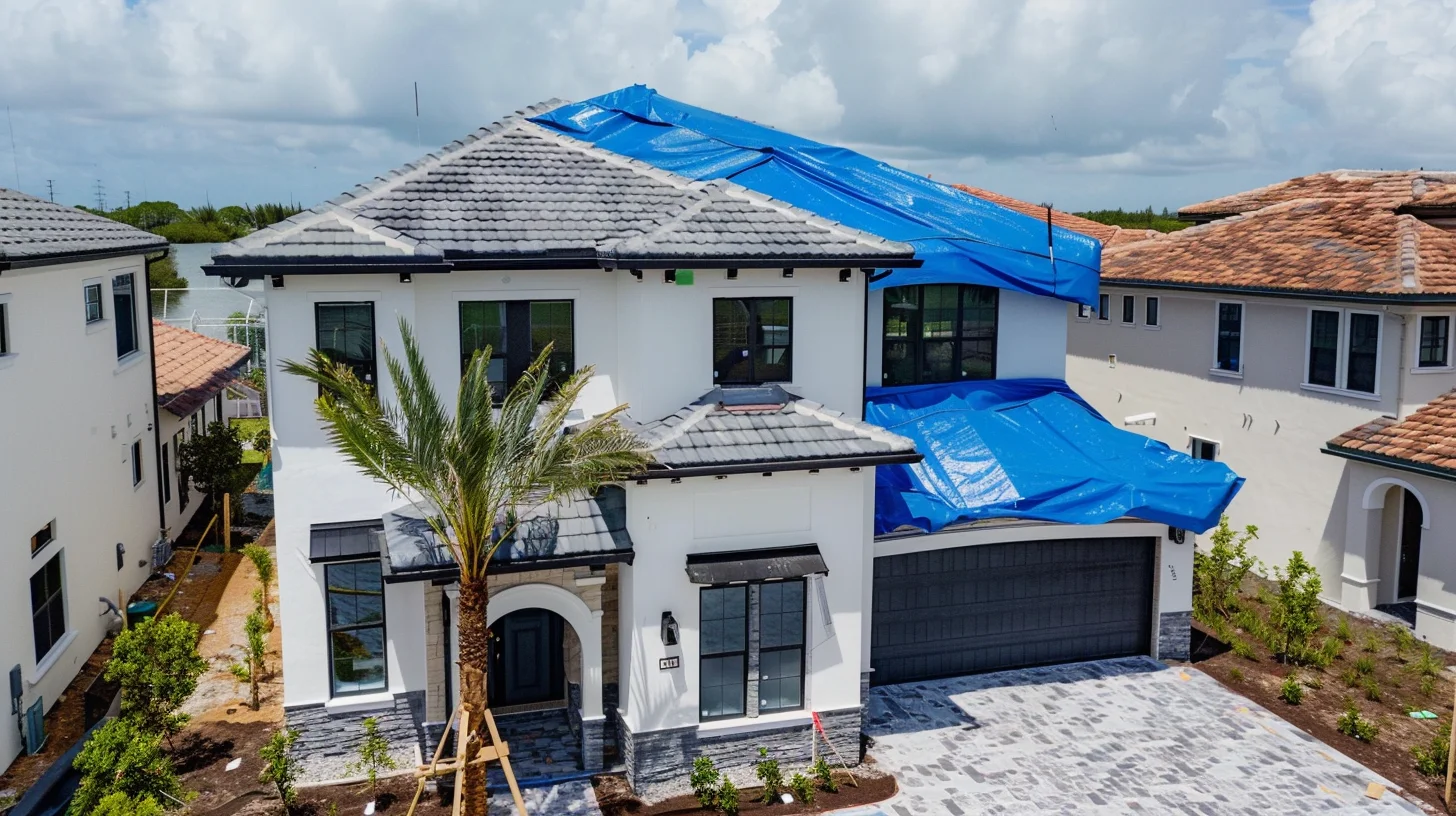
A tree on your roof means open exposure to the sky. Every hour without a tarp risks additional water intrusion, mold clock starting, and secondary damage that your insurer may not cover if you failed to mitigate. Call us now — same-day tarping is available in most Gulf and Atlantic coastal markets. Keep receipts — emergency tarping is reimbursable under your homeowner's policy.
Call your homeowner's insurer to open the claim
File the claim under your own policy — not your neighbor's. Have your policy number ready. Report it as wind/storm damage with a falling tree. Ask your insurer specifically: "Do you have a subrogation unit? Should I preserve any specific evidence regarding the tree's condition?" Get a claim number before ending the call.
Talk to your neighbor — carefully
Inform your neighbor as a courtesy — and to exchange contact and insurance information. But be careful about what you say and what you sign. Do not: accuse them of negligence verbally (this poisons the relationship without legal benefit), sign any document they present, agree to let their contractor handle your repairs, or accept any cash payment without consulting your insurer first. Do: get their full name, address, phone number, homeowner's insurance company, and policy number.
Assess the negligence question with your insurer
Tell your insurer everything you know about the tree's prior condition. Did you or anyone else ever complain to the neighbor about it? Was it visibly dead or diseased? Had anyone obtained an arborist assessment? Your insurer's subrogation team will evaluate whether there's a viable negligence case — and pursue it on your behalf if so. You don't need to make this decision yourself.
Have the fallen tree professionally assessed before removal
Before any tree removal service cuts up and hauls away the fallen tree, have a certified arborist assess and document the tree's condition — specifically whether there was pre-existing disease, structural failure, or rot that would have been visible or knowable before the storm. This report is the foundation of any negligence claim and is used by your insurer's subrogation unit. Once the tree is removed, that evidence is gone.
The core "Act of God" principle applies everywhere, but negligence standards and related statutes vary by state. Here's a practical overview for each state in the StormRoofQuotes network:
| State | Negligence Standard | Notice Requirement | Key Cases / Statutes |
|---|---|---|---|
| Florida | Prior written notice of hazardous condition required. Storm-caused falls from healthy trees: Act of God. | Written notice to owner; reasonable time to respond | Contrary to Gatto v. City of Boca Raton line; consult FL attorney |
| Texas | Negligence requires actual or constructive knowledge of tree's hazardous condition. Storm falls: owner generally not liable. | Prior complaints or visible defect observable by reasonable person | Bader v. Dist. Court of App.; common law negligence standard applies |
| Louisiana | Civil Code Art. 2317.1 — owner liable if they knew or should have known of ruin or defect and failed to repair. Diseased trees may create liability even without notice. | Knowledge (actual or constructive) of defect | La. Civ. Code Art. 2317, 2317.1; more plaintiff-friendly than most states |
| Mississippi | Prior knowledge of hazardous condition required. Healthy tree in storm: Act of God defense applies. | Documented prior notice preferred | Common law negligence; no specific tree statute |
| Alabama | Prior notice of tree's dangerous condition required for liability. Contributory negligence state — any fault on your part may bar recovery. | Written notice strongly preferred | Alabama is a contributory negligence state — consult an attorney before pursuing |
| Georgia | O.C.G.A. § 44-7 area; prior knowledge of hazardous condition required. Comparative fault applies. | Actual knowledge preferred; arborist report is strong evidence | Johnson v. Cartee; Holmes v. Clisby line of cases |
| South Carolina | Prior knowledge or notice of hazardous condition required. Comparative fault state. | Written notice; certified arborist assessment helpful | Common law negligence; no specific tree statute |
| North Carolina | Prior notice of hazardous condition required. Contributory negligence state — any fault bars recovery entirely. | Written notice; NC is strict on contributory negligence | NC is one of only 4 pure contributory negligence states — consult attorney before pursuing |
| Virginia | Prior notice of hazardous condition required. Contributory negligence state. | Written notice; actual knowledge required | Virginia is pure contributory negligence — attorney consult essential |
| Maryland | Pending v. Galbraith standard — prior knowledge of hazardous condition required. Contributory negligence state. | Written notice preferred; visible defect may establish constructive notice | Maryland is contributory negligence — any fault on your part may bar recovery |
| Delaware | Prior notice or knowledge of hazardous condition required. Comparative fault applies. | Written notice; arborist assessment valuable | Comparative fault — proportional recovery even with partial fault |
| New Jersey | Prior knowledge of hazardous condition required. Urban/suburban rule: property owners have affirmative duty to inspect trees abutting public ways. | Constructive notice may apply — "should have known" standard in some NJ cases | Ivins v. Westfield; NJ takes a somewhat more plaintiff-friendly approach than most states |
| New York | Prior notice of hazardous condition required. Comparative fault applies. NYC has specific tree ordinances. | Written notice; NYC 311 complaints create documented record | Ivancic v. Olmstead; Basso v. Miller; NYC Admin Code § 18-129 |
Four of the thirteen states in our network — Alabama, North Carolina, Virginia, and Maryland — still follow the old common law doctrine of pure contributory negligence. This means that if you are found to bear any percentage of fault for the damage — even 1% — you are completely barred from recovering damages from your neighbor. This is a harsh rule that makes pursuing negligence claims in these states significantly more risky without an attorney.
If you are in one of these four states and believe your neighbor was negligent, consult a personal injury or property damage attorney before taking any action — including what you say to your insurer or your neighbor — that could be construed as admitting partial fault.
Only if you can prove negligence — that they knew the tree was hazardous and ignored it. If the tree was healthy and fell in a storm, it's an Act of God and your deductible is your responsibility. However, if your insurer pursues subrogation and succeeds against your neighbor's liability insurer, you may recover your deductible as part of the subrogation recovery. Tell your insurer everything you know about the tree's condition before the storm.
They are not right — and neither are they obligated to file a claim. Their homeowner's liability coverage only responds if they were negligent. A storm causing their healthy tree to fall is not negligence. Some neighbors voluntarily offer to help with deductibles as a goodwill gesture — that is their choice, but they have no legal obligation in the absence of provable negligence. File your own claim regardless of what your neighbor says or offers.
Did you warn them in writing? If yes — certified letters, emails, or text messages showing you identified the specific tree as a hazard and requested action — you have the foundation of a negligence case. Contact your insurer's subrogation unit immediately with that documentation, and consider consulting a property damage attorney. If the warnings were only verbal, you have a harder case — but the post-fall arborist assessment of the tree's pre-storm condition, combined with your testimony, may still be sufficient in some states.
Not automatically — but it improves your case significantly. The key question is whether your neighbor knew or reasonably should have known the tree was diseased or hazardous. If the rot was visible from the street or from your property before it fell, a court may find they had constructive notice even without formal written warning. Have a certified arborist assess and document the tree's pre-storm condition immediately before it is removed. That report is your primary evidence.
You can — but be very careful. If you accept payment from your neighbor and sign any kind of release, you may be blocking your own insurer's subrogation rights if you later need to file a claim. You should also consider: what if the true repair cost turns out to be higher than what your neighbor offers? What if hidden damage is discovered during repairs? Once you've released your neighbor, you lose those options. Talk to your insurer before accepting any payment or signing anything.
Possibly — but the circumstances matter. Most insurers consider the nature of the claim when evaluating rate impact. A single tree-fall claim during a named storm or declared disaster is generally treated differently than a pattern of preventable claims. In states with Citizens Property Insurance or other state wind pools, claims during declared disasters may have specific rate protections. Ask your insurer directly before filing whether this type of claim will affect your rate — and weigh that against your repair costs and deductible amount.
You have a duty to mitigate further damage — meaning you should take reasonable steps to prevent additional harm to your property. Emergency tarping is always appropriate immediately. For the tree itself: if it poses an active safety risk (unstable, threatening further collapse), document everything thoroughly first, then proceed with emergency stabilization or removal. Notify your insurer before or immediately after any emergency removal. Keep all receipts. For non-emergency situations, coordinate with your insurer — many adjusters prefer to see the tree in place during their inspection.
Your landlord's insurance covers the building. Your renter's insurance covers your personal property. If you have renter's insurance, file a claim for any personal property damaged by the impact or resulting water intrusion. If you don't have renter's insurance, you have limited options for personal property recovery — FEMA Individual Assistance may cover personal property if your county is declared a disaster area. If the building is uninhabitable, FEMA rental assistance may cover temporary housing. Your landlord is responsible for making the building habitable — if they fail to act promptly, document everything and consult a tenant's rights organization in your state.
Free damage assessment, same-day tarping available in most coastal markets. Get your claim documentation started before the next storm arrives.
🚨 Request Same-Day Help →Active leak or major storm damage? We can get someone to you fast — or help you tarp right now.
📞 Request Same-Day Callback 🛖 Emergency Tarping Guide →